
Introduction
In today’s hyper-connected digital world, cybersecurity is no longer just a textbook subject—it’s a battlefield. Every day, organizations face sophisticated attacks that bypass traditional defenses. New vulnerabilities are discovered. Threat actors adapt. Tools evolve.
Yet, in many classrooms and online courses, students are still learning from outdated slides and memorizing definitions. While theoretical knowledge is important—understanding what a firewall is or how the OSI model works—it only scratches the surface.
Now, imagine this.
You’ve spent weeks learning about port scanning in theory. You’ve read about TCP flags, Nmap command syntax, and how attackers use scans to map a network.
But then, in a live lab or a job interview, you’re asked:
“Can you run an Nmap scan against this target and identify open ports?”
Suddenly, you're staring at the terminal. Your hands freeze.
The theory vanishes from your mind.
Why? Because you’ve never done it before.
This is the gap that hands-on training fills. It transforms passive learning into practical skill, builds confidence through experience, and prepares you for real-world scenarios—not just written exams.
In this blog, we’ll explore why hands-on cybersecurity training isn’t optional—it’s essential. Whether you’re a student, a beginner, or someone switching careers, this article will show you exactly why labs are the fastest way to learn, grow, and thrive in the cybersecurity world.
The Theory-Heavy Trap in Cybersecurity Education
Many traditional IT and cybersecurity courses are heavily tilted toward theory. You’ll find:
Long chapters on OSI models
Definitions of threat actors
Lists of security protocols
Essay-style questions in exams
While these topics are important, they don’t prepare you for live attacks, mis-configured firewalls, or log analysis under pressure.
Common Pitfalls of Theory-Only Learning:
Can't apply knowledge in real-world situations
Memorize instead of understanding
Struggle in technical interviews or CTFs
No exposure to tools like Wireshark, Metasploit, or Burp Suite
Imagine trying to learn swimming by reading a book—that’s exactly what theory-only cybersecurity training feels like.
What Hands-on Learning Really Means
Hands-on training means you don’t just learn what a cyberattack is—you simulate one.
It’s the difference between:
Reading about phishing emails vs. building and analyzing one in a lab
Learning how a firewall works vs. configuring one to block malicious traffic
Memorizing OSI layers vs. using Wireshark to dissect real packets
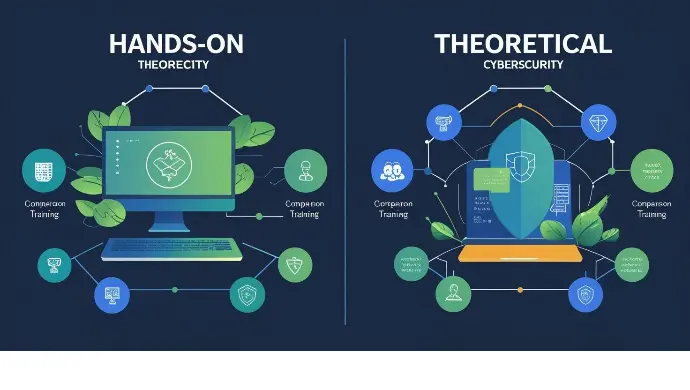
Case Study: The Firewall That Theory Missed
Let’s say you’re asked to configure a basic inbound rule on a firewall.
You know the theory:
Allow port 443 for HTTPS traffic.
But when nothing works in production, you freeze.
Hands-on learners, however, know to:
Check ACLs
Inspect NAT settings
Review logs for denial reasons
Use packet captures for inspection
Real-world issues rarely match the textbook.
What the Industry Wants: Skills over Degrees
Today, companies like Google, IBM, and Palo Alto Networks care less about your degree and more about what you can do.
💼 Common Job Descriptions Say:
"Experience with vulnerability scanners like Nessus"
"Familiarity with SIEM tools"
"Hands-on exposure to cloud firewalls"
The keyword is "experience." You get that from labs, not lectures.
Getting Started with Hands-on Cybersecurity Labs
You don’t need expensive hardware. Start with:
🧪 Beginner Lab Ideas:
Set up a Virtual Machine with Kali Linux
Use Wireshark to monitor your network
Simulate an ARP spoofing attack in Packet Tracer
Create custom firewall rules in pf Sense
⚙️ Tools You Can Use:
Virtual Box or VMware Workstation Player
Cisco Packet Tracer
Certkraft's own guided lab platform (scroll below)
Why Certkraft Is Built for Hands-on Learners
At Certkraft, we understand that cybersecurity can't be learned by watching videos alone.
That’s why every course includes:
🧠 Interactive challenges
🧪 Real-world lab scenarios
📊 Progress tracking
🔐 Safe environments to simulate attacks and defences
☁️ Cloud-based VMs—no local setup required
We design labs aligned with real job roles: SOC Analyst, Pen Tester, Cloud Security Engineer, and more.