OSI & TCP/IP Model
A foundational concept for mastering networking, troubleshooting, and certification success
Introduction to the OSI Model
☑️The OSI model was first introduced in 1983 and adopted by ISO.
☑️Serves as a universal framework that promotes
☑️Supported by major computer & telecom companies.
☑️Provides a visual guide to how data moves across networks.
Breaking complex communication into 7 defined layers simplifies standardization, interoperability, and troubleshooting
Application Layer
The Application Layer is the topmost layer in the OSI Model. It directly interacts with end-user applications such as web browsers, email clients, and file-sharing tools. This layer serves as a window between user-facing software and the underlying network services.
It provides protocols and services that enable meaningful user-level communication over the network.
Key Functions of the Application Layer
☑️Enables users to log on to a remote host using Network Virtual Terminal
☑️Allows access, retrieval, and management of files on remote machines
☑️Supports email operations like sending, receiving, and forwarding messages
☑️Provides access to distributed databases (e.g., LDAP)
☑️Facilitates file interaction across systems over a network
☑️Assists in monitoring and managing network performance and behavior
Presentation Layer
Also known as the Syntax Layer or Translation Layer, the Presentation Layer ensures that data from one system is understood and properly formatted for another. It facilitates interoperability between devices using different data encoding and formatting techniques.
Key Functions of the Presentation Layer
☑️Converts data between application formats and network formats (e.g., ASCII to EBCDIC) and also ensures data from the sender is correctly interpreted by the receiver.
☑️Ensures secure data transmission over the network by encrypting data before sending (ciphertext) and decrypting it upon receiving (plaintext) using algorithms and key-based encoding (e.g., TLS/SSL).
☑️Helps in Compression and Decompression of data.
Session Layer
The Session Layer manages sessions (conversations) between applications on two devices. It is responsible for establishing, maintaining, and terminating logical connections. It enables coordinated communication in a reliable and organized manner and supports authentication, authorization, and session recovery when needed.
Key Functions of the Session Layer
☑️Manages Session Establishment, Maintenance, and Termination..
☑️Helps resume transmission from the last checkpoint if there’s a failure, avoiding data loss.
☑️Manages dialog modes, Full-duplex and Half Duplex.
Transport Layer
The Transport Layer is responsible for end-to-end communication between hosts. It ensures reliable and complete data transfer across the network by performing error detection, correction, flow control, and data segmentation.
Key Functions of the Transport Layer
☑️Breaks large messages into smaller segments for efficient transmission.
☑️Each segment includes a header with control information (e.g., port numbers)
☑️At the receiving end, segments are sequenced and reassembled into the original message.
☑️Implements mechanisms to detect transmission errors.
☑️Ensures acknowledgment of successful data delivery and re-transmits lost data.
Network Layer
The Network Layer is responsible for routing, forwarding, and logical addressing of data across networks. It ensures that data is successfully delivered from source to destination across interconnected networks. This layer assigns IP addresses, encapsulates data into packets, and operates through devices like routers and Layer 3 switches.
Key Functions of the Network Layer
☑️Determines the optimal path for data packets to travel from source to destination.
☑️Takes into account network conditions, link costs, and service priorities.
☑️Assigns unique IP addresses to devices on the network.
Data Link Layer
- Logical Link Control (LLC) – Handles error checking and flow control
- Media Access Control (MAC) – Manages access to the physical transmission medium
Key Functions of the Data Link Layer
☑️Transfers data between devices on the same local network by adding MAC addresses to identify the sender and receiver
☑️Structures data into frames for transmission
☑️Manages frame synchronization, flow control, and access to the physical medium
Physical Layer
The Physical Layer is the lowest layer of the OSI model and is responsible for the actual physical connection between devices. It transmits raw binary bits over a physical medium (e.g., cables, fiber, radio waves) and ensures that data travels from sender to receiver as electrical, optical, or radio signals.
This layer deals with the hardware elements of networking, such as cables, repeaters, hubs, and modems, and plays a critical role in defining topology, data transmission rates, and synchronization.
Key Functions of the Presentation Layer
☑️Manages bit synchronization between devices and controls the bit rate (bits per second) to ensure smooth data flow.
☑️Defines physical topologies (star, mesh, bus), and supports data flow modes like simplex, half-duplex, and full-duplex communication.
☑️Converts digital bits into transmittable signals (modulation) and defines the physical medium (cables, connectors, voltage, frequencies).
OSI Model Flashcards
Click on each card to flip and reveal the answer on the back side.
Introduction to the TCP/IP Model
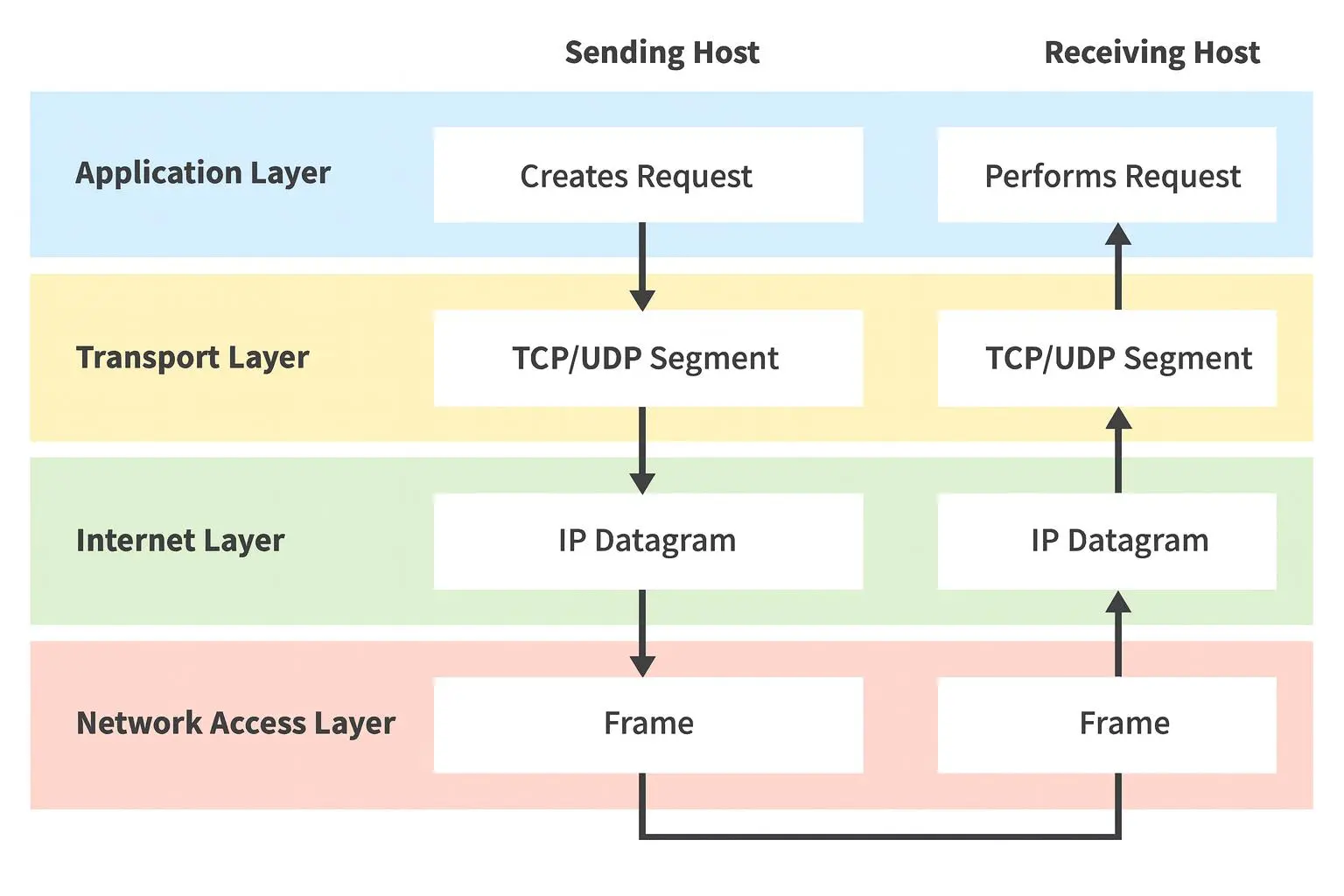
The TCP/IP model is also a framework that helps in understanding network communication. It consists of four layers: the Application Layer, Transport Layer, Internet Layer, and Network Access Layer. While the OSI model has seven layers, the simpler four-layer TCP/IP model is more commonly used in today’s internet and networking systems.
One of the main roles of the TCP/IP model is to handle the transmission of data from the sender to the respective receiver. To perform this transaction, the data is divided into smaller parts known as packets. These packets travel independently and are reassembled in the correct order upon reaching the destination. This approach primarily helps to prevent errors during transmission.
1. Application Layer
The Application Layer is the topmost layer of the TCP/IP model. It contains user-level applications such as web browsers and email clients. This layer acts as a bridge between the software and the lower layers of the network stack, enabling user interaction with network services.
2. Transport Layer
This layer is responsible for ensuring that data is sent reliably and in the correct order between the sender and receiver. It uses two key protocols:
TCP (Transmission Control Protocol) – Provides reliable communication. It checks for errors, maintains the order of packets, and resends any missing packets. It is typically used for web browsing, file downloads, and applications requiring accuracy.
UDP (User Datagram Protocol) – Provides faster but less reliable communication. It doesn’t guarantee delivery or order, making it suitable for video streaming, online gaming, and real-time collaboration where speed is critical.
3. Internet Layer
This layer determines the best path for data to travel from the sender to the receiver. Acting like a traffic controller, it routes packets across different networks. It uses the Internet Protocol (IP) to assign unique addresses, ensuring the data reaches the correct destination. Additional responsibilities include routing, forwarding, addressing, and fragmentation of data.
4. Network Access Layer
The Network Access Layer is the lowest layer in the TCP/IP model. It handles the physical transmission of data between devices over the network. This includes both wired and wireless media. It is responsible for assigning MAC addresses, creating frames, and performing basic error checks during transmission.